A guide to understanding the Additional Learning Needs system
In 2021, the Additional Learning Needs (“ALNˮ) system in Wales began to gradually replace the Special Educational Needs (“SENˮ) system, establishing a consistent framework for supporting children and young people aged 0–25 with additional needs.
Initial forecasting anticipated that the SEN system would be fully phased out by August 2024. However, in 2023 Welsh Government extended the transition period to August 2025.
As of September 2025, the SEN framework was formally replaced by the ALN system in Wales, with the removal of SEN provisions such as Statements of SEN and School Action/School Action Plus Plans.
Despite the four-year transitionary period, many parents, carers and young people still struggle to understand their rights under the ALN legislation, navigate the system, and plan for transitions.
What is an Individual Development Plan?
The Additional Learning Needs and Education Tribunal (Wales) Act 2018 introduced Individual Development Plans (“IDPsˮ), intended to replace Statements of SEN and School Action/School Action Plus plans.
An IDP is a legal document setting out a child or young personʼs (aged 0–25) additional learning needs and the additional learning provision (“ALPˮ) required to meet those needs.
The IDP identifies who is responsible for delivering the provision and the outcomes the learner should achieve with that support.
When is an IDP required?
To determine whether your child is entitled to an IDP, it is important to understand the definitions of ALN and ALP.
| Additional Learning Needs | Additional Learning Provision |
|
A child of compulsory school age or person over that age has a learning difficulty or disability if he or she—
A) has a significantly greater difficulty in learning than the majority of others of the same age, or
B) has a disability for the purposes of the Equality Act 2010 which prevents or hinders him or her from making use of facilities for education or training of a kind generally provided for others of the same age in mainstream maintained schools or mainstream institutions in the further education sector.
|
Additional learning provision for a person aged three or over means educational or training provision that is additional to, or different from, that made generally for others of the same age in—
A) mainstream-maintained schools in Wales,
B) mainstream institutions in the further education sector in Wales, or
C) places in Wales at which nursery education is provided.
Additional learning provision for a child aged under three means educational provision of any kind. |
Therefore, if your child has ALN and ALP is necessary to meet those needs, an application for an IDP can and should be made.
The IDP process
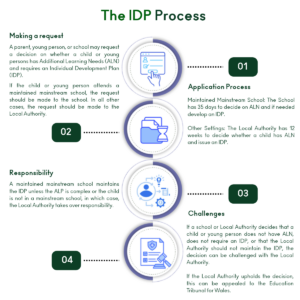
A parent, young person, or school can make a request for a decision on whether the child or young person has ALN and may require an IDP.
If the child attends a maintained mainstream school:
- The request should be made to the school in writing
- The school has 35 school days to decide whether the child has ALN and requires ALP
- If the child does have ALN, the school must prepare and maintain an IDP within 35 school days of the initial request.
Schools must maintain the IDP where the childʼs ALP can reasonably be provided from the schoolʼs own resources, its delegated ALN budget, and ordinarily available external services.
A Local Authority takes over responsibility for maintaining the IDP when:
- The ALP provided is complex, intensive or costly.
- The ALP requires muti-agency coordination at Local Authority level.
- The ALP cannot reasonably be delivered from the schoolʼs delegated resources.
- The child attends a maintained special school.
- The child is not on roll at a maintained school.
For children or young people not attending a maintained mainstream school, the request should be made directly to the Local Authority, which has 12 weeks to decide whether the child has ALN and, if so, to prepare and issue the IDP.
How to challenge a decision about ALN or an IDP
If a school decides that the child or young person does not have ALN, you may ask the Local Authority to reconsider. The Local Authority must then make an independent decision within 7 weeks.
If the Local Authority finds that the child or young person does have ALN, it must either prepare and maintain an IDP or direct the school to do so.
If you are unhappy that the school is maintaining the IDP, or you disagree with the content, you can request that the Local Authority takes over responsibility and/or redrafts the IDP. The Local Authority must issue its decision in writing within 7 weeks.
Decisions made by the Local Authority are appealable to the Education Tribunal for Wales. These decisions can include:
- A decision that a child does not have ALN.
- A refusal to prepare an IDP.
- A refusal to maintain an IDP.
- Disagreements over the contents of an IDP
The Education Tribunal for Wales exists to resolve disputes between parents, young people, further education institutions, and Local Authorities regarding ALN and IDPs. It is an independent Tribunal, and its decisions are binding.
Get the right team by your side
Getting an IDP and securing the right support for a child or young person in Wales can be challenging. Some families spend months or even years trying to secure appropriate provision, which can be stressful and exhausting.
Appealing a Local Authority decision to the Education Tribunal for Wales is a legal process, and many families find it overwhelming.
Our education team specialises in supporting young people and their families throughout the IDP process. We work closely with families to advise them and conduct appeals on their behalf, ensuring their needs are heard and understood so they can access the support required to thrive in education.
Not only do we understand the legal process, but we also understand our families and the challenges they face. Many members of our team have personal experience with ALN, and you will always be treated with compassion and empathy.